
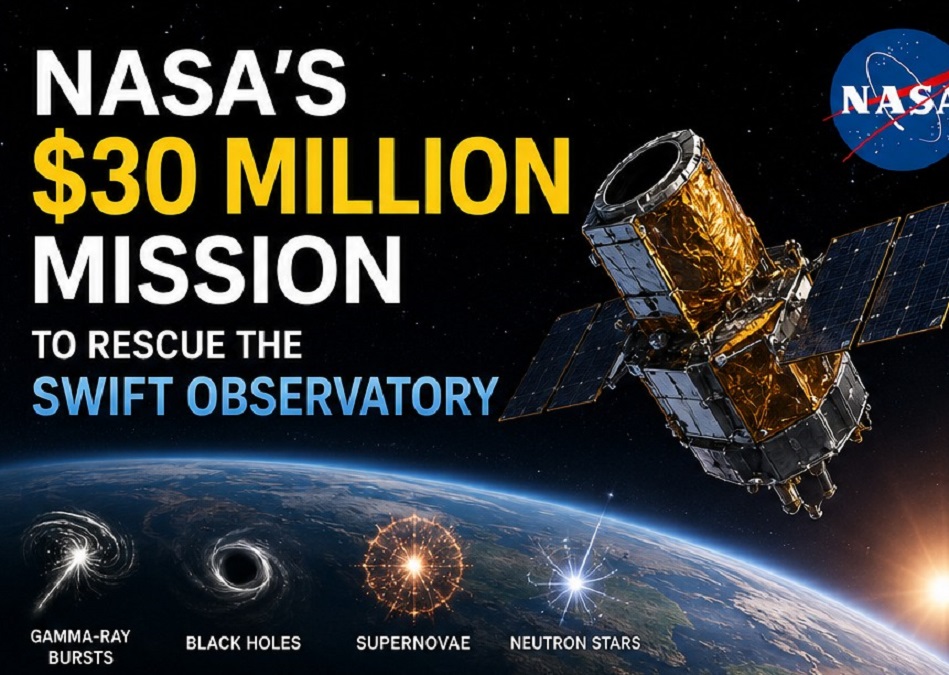
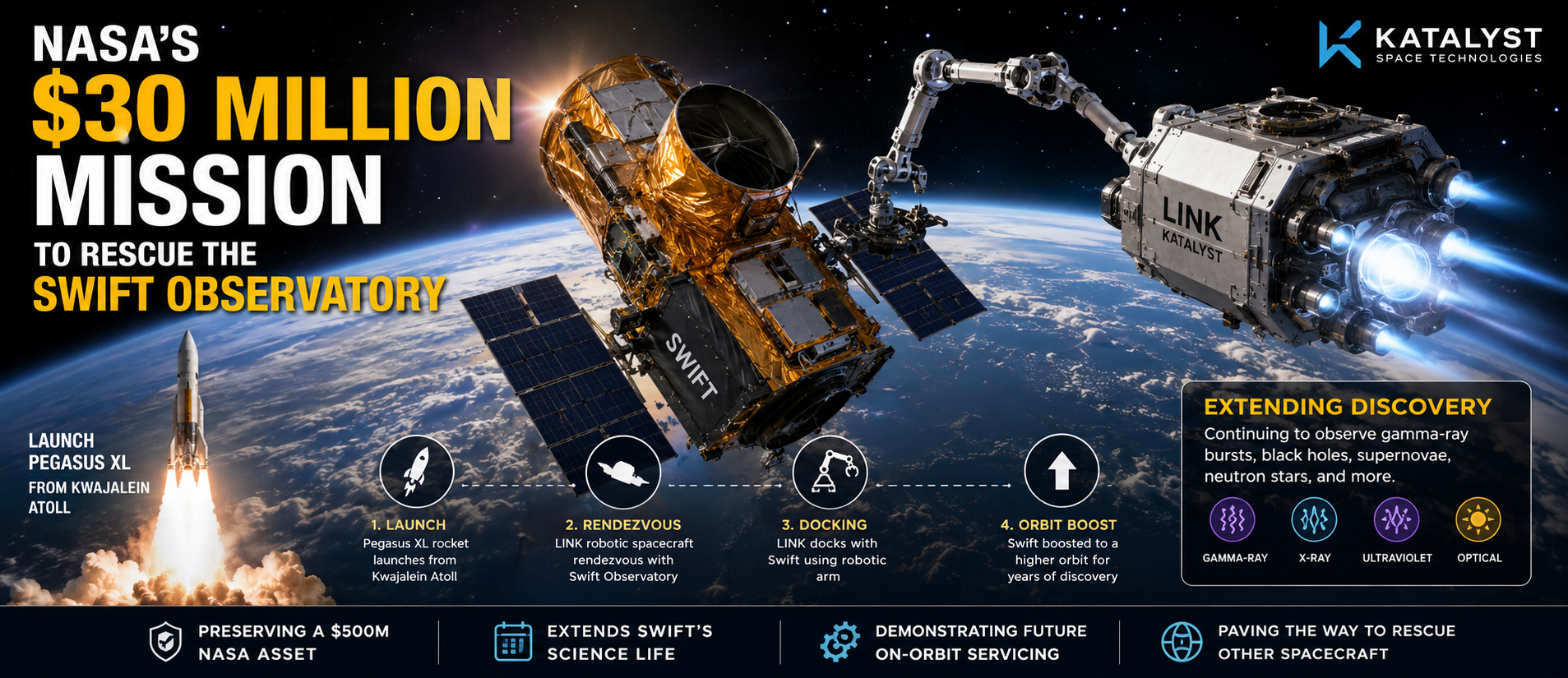
NASA is preparing a $30 million mission to save the nearly 22-year-old Neil Gehrels Swift Observatory, a spacecraft launched in 2004 to study gamma-ray bursts and other high-energy cosmic events. Swift’s orbit has gradually decayed over time, and recent increases in solar activity have accelerated that decline, raising the risk that the observatory could eventually burn up in Earth’s atmosphere.
The rescue plan calls for Katalyst Space Technologies’ LINK robotic spacecraft to launch aboard a Northrop Grumman Pegasus XL rocket. The aircraft-launched rocket will take off from Kwajalein Atoll in the South Pacific Ocean, and the robotic vehicle will then attempt to dock with Swift and boost it to a higher orbit over the following months.
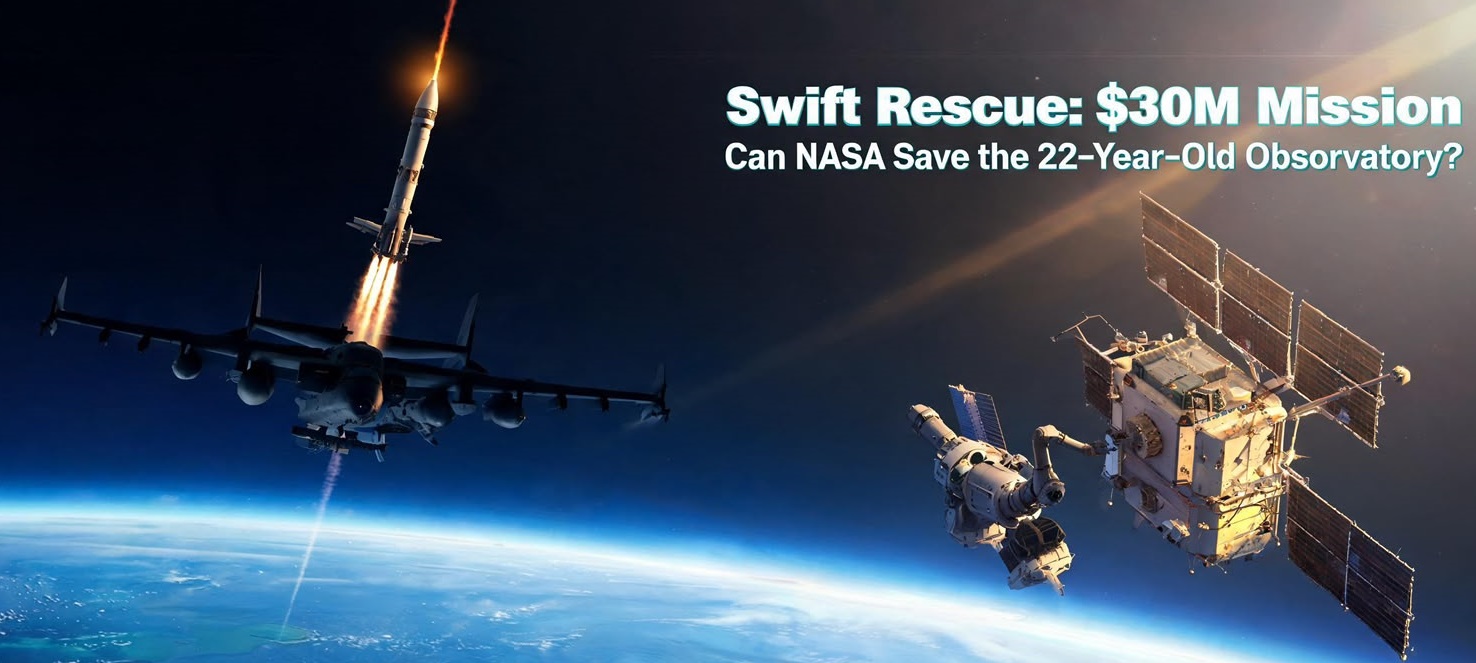
If successful, the mission could extend Swift’s scientific life by several more years and preserve a valuable NASA asset that continues to observe gamma-ray bursts, black holes, supernovae, neutron stars, and other extreme phenomena. NASA says Swift remains an important multiwavelength observatory because it can quickly detect bursts and coordinate follow-up observations across gamma-ray, X-ray, ultraviolet, and optical bands.
Katalyst says the same autonomous servicing technology could later be used to reposition or extend the life of other satellites and space telescopes, including spacecraft that were never designed to be docked with. NASA’s Swift Boost page also notes that the mission is intended to demonstrate rendezvous and boosting of an unprepared spacecraft, which is a major step for future on-orbit servicing.
References
1. NASA, “Swift Boost Mission” — https://www.nasa.gov/missions/swift/swift-boost-mission/
2. NASA Science, “Swift Boost Mission” — https://science.nasa.gov/mission/swift/swift-boost-mission/
3. NASA, “Swift” mission page — https://science.nasa.gov/mission/swift/
4. Katalyst Space Technologies, “Katalyst Selects Northrop Grumman Pegasus Rocket for Robotic Rescue Mission” — https://www.katalystspace.com/news/katalyst-selects-northrop-grumman-pegasus-rocket-for-robotic-rescue-mission
5. Katalyst Space Technologies, “Katalyst Develops Design for NASA to Rescue $500M Space Telescope from Uncontrolled Reentry” — https://www.katalystspace.com/news/katalyst-develops-design-for-nasa-to-rescue-500m-space-telescope