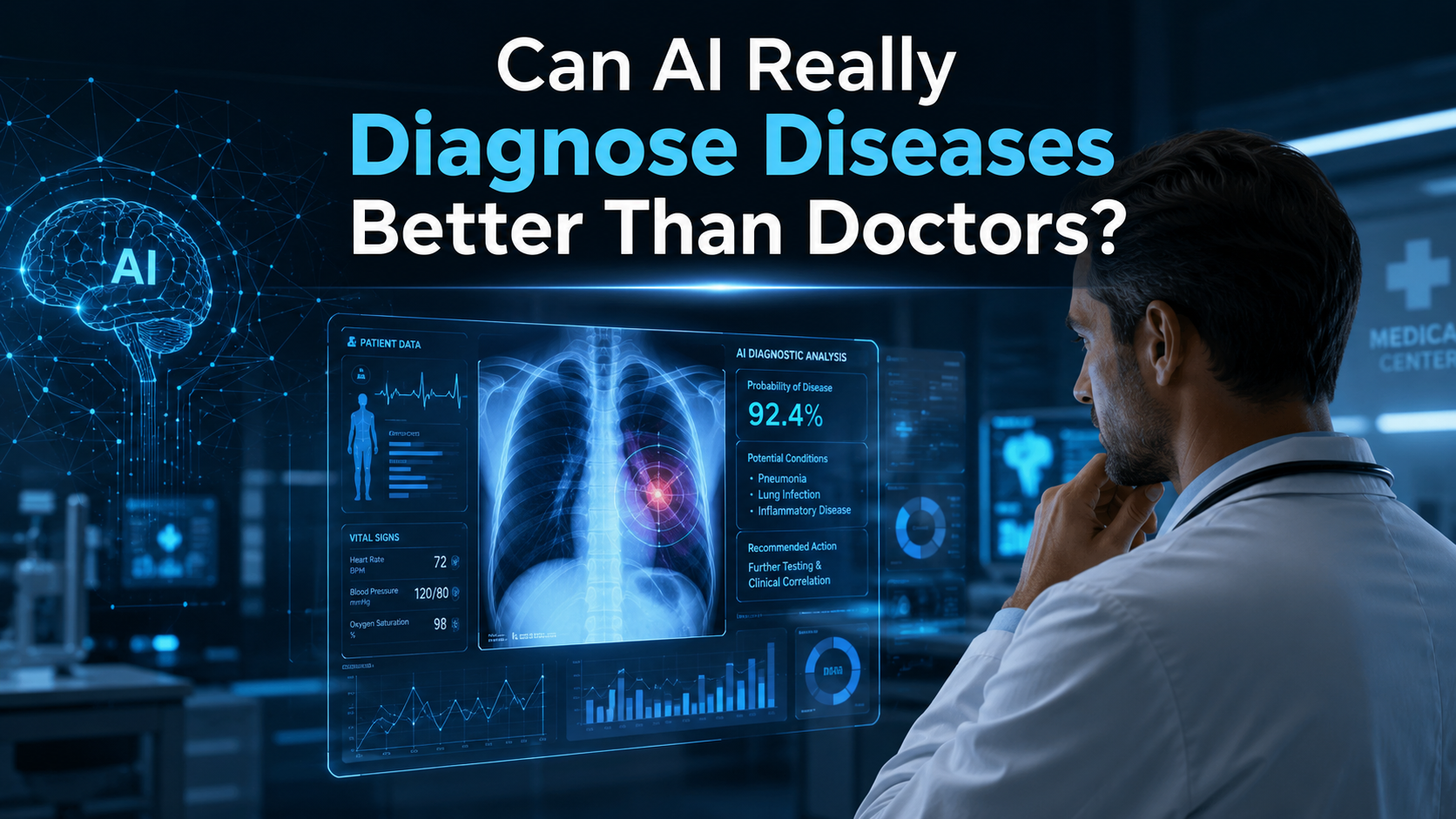
Artificial intelligence is rapidly changing the way modern medicine is practiced. From analyzing medical images to detecting patterns in patient data, AI in healthcare is becoming an increasingly important tool for doctors, researchers, and hospitals.
But one question continues to attract enormous attention:
Can artificial intelligence actually diagnose diseases better than doctors?
The answer is more complicated than a simple yes or no.
AI can outperform clinicians in certain narrowly defined diagnostic tasks, particularly when analyzing large amounts of structured data or medical images. However, diagnosing a patient involves much more than recognizing a pattern. Doctors consider symptoms, medical history, physical examination, test results, risk factors, and the patient’s individual circumstances.
So, is AI replacing doctors—or is it becoming one of medicine’s most powerful diagnostic assistants?
Let’s examine what the science really tells us.
What Is AI Diagnosis?
AI diagnosis refers to the use of artificial intelligence and machine-learning systems to analyze medical information and help identify diseases or health conditions.
Depending on the system, AI can analyze:
- Medical images such as X-rays, CT scans, MRIs, and pathology slides
- ECG and other physiological signals
- Laboratory results
- Electronic health records
- Genetic and genomic information
- Patient symptoms and clinical histories
Modern AI systems can identify patterns across enormous datasets that would be difficult for a human to process manually.
The FDA maintains a growing list of AI-enabled medical devices authorized for marketing in the United States, including systems used in radiology, cardiovascular medicine, ultrasound, and other areas.
How Does Artificial Intelligence Diagnose Diseases?
Most medical AI systems are trained using large datasets containing examples of medical conditions.
For example, researchers might provide an AI model with thousands of medical images that have already been interpreted by specialists.
The system learns statistical patterns associated with particular diseases.
When presented with a new image, the AI can estimate whether certain abnormalities are present.
This process can happen extremely quickly.
However, AI does not “understand” disease in exactly the same way a physician does. It primarily identifies patterns and relationships within the data on which it was trained.
That distinction is extremely important.
Can AI Detect Diseases Better Than Doctors?
In some specific diagnostic tasks, yes—AI can achieve extremely high performance and may outperform individual doctors under controlled conditions.
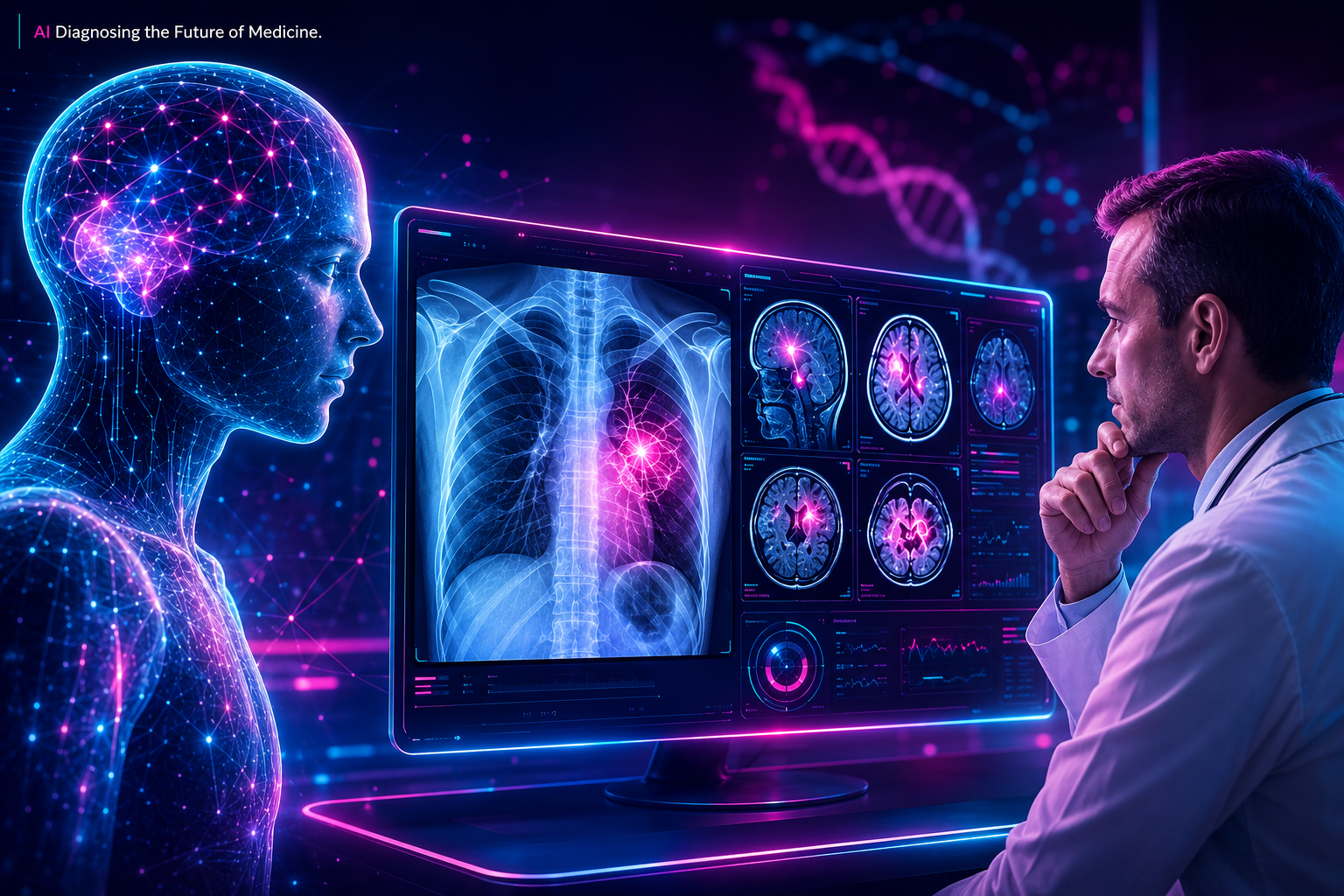
Medical imaging is one of the most important examples.
AI can examine thousands of pixels, measurements, and patterns within an image and flag abnormalities that may be difficult to notice.
But saying that “AI is better than doctors” is misleading.
A diagnostic model designed specifically to identify abnormalities in an X-ray is not equivalent to a physician responsible for diagnosing an entire patient.
A doctor may need to determine:
- What symptoms the patient has
- How long the symptoms have existed
- Which diseases are most likely
- Which tests should be ordered
- Whether multiple conditions could be occurring simultaneously
- What treatment should be considered
- Whether the AI’s recommendation makes clinical sense
Therefore, AI may be better at certain tasks without being better at medicine as a whole.
Where Is AI Already Being Used in Medical Diagnosis?
AI is already being incorporated into several areas of healthcare.
1. Medical Imaging
Radiology is one of the most developed applications of medical AI.
AI systems can help analyze:
- X-rays
- CT scans
- MRI scans
- Mammograms
- Ultrasound images
They can highlight suspicious regions and help clinicians prioritize cases.
2. Cancer Detection
AI is being investigated and deployed for detecting patterns associated with different cancers.
For example, machine-learning systems can analyze medical images and pathology data to identify suspicious abnormalities.
The goal isn’t simply to find cancer faster—it is also to improve consistency and help clinicians manage increasingly large volumes of medical data.
3. Cardiovascular Disease
AI can analyze ECG signals and other cardiovascular information to identify patterns associated with heart conditions.
The FDA’s current AI-enabled device listings include cardiovascular applications, demonstrating that this technology is moving beyond research laboratories into regulated medical products.
4. Neurological Disorders
Researchers are also investigating AI for conditions affecting the brain, including Alzheimer’s disease, Parkinson’s disease, stroke, and other neurological disorders.
AI can analyze complex combinations of imaging, clinical, and biological data that may help researchers identify disease-associated patterns.
Why Can AI Be So Good at Diagnosis?
One major advantage of AI is its ability to process enormous quantities of information.
A physician may see thousands of patients during a career.
An AI model can potentially analyze millions of data points during development and evaluation.
AI can also perform the same computational task repeatedly without becoming tired or distracted.
This creates several potential advantages:
Speed: AI can analyze certain datasets extremely quickly.
Pattern recognition: Machine-learning models can identify subtle statistical patterns.
Consistency: An algorithm can apply the same computational process repeatedly.
Scalability: One validated system can potentially support many healthcare environments.
WHO recognizes that AI could help address healthcare challenges and improve diagnosis and clinical care, while emphasizing that responsible implementation and governance are essential.
But AI Has a Major Weakness: It Can Be Wrong
This is where the story becomes much more complicated.
AI systems can produce highly confident predictions that are incorrect.
One major reason is training data.
If an AI system is trained primarily on data from one population, hospital, imaging device, or demographic group, its performance may not transfer perfectly to another environment.
WHO has specifically highlighted concerns involving biased or non-representative data, accuracy, transparency, and safety in healthcare AI.
An algorithm can therefore appear extremely accurate in testing but perform differently when deployed in the real world.
The Problem of AI Bias in Healthcare
Imagine an AI model trained mostly using medical data from one population.
If patients in another population have different characteristics, disease patterns, or healthcare histories, the model may perform less accurately.
This is known as algorithmic bias.
In medicine, bias is particularly serious because an incorrect prediction can affect a person’s diagnosis, treatment, or access to healthcare.
For this reason, researchers need to evaluate AI systems across diverse populations and real-world clinical environments.
AI vs Doctors: Who Is Better?
The most useful question may not be:
“Will AI replace doctors?”
Instead, researchers are increasingly interested in another question:
“Can doctors using AI perform better than doctors or AI working alone?”
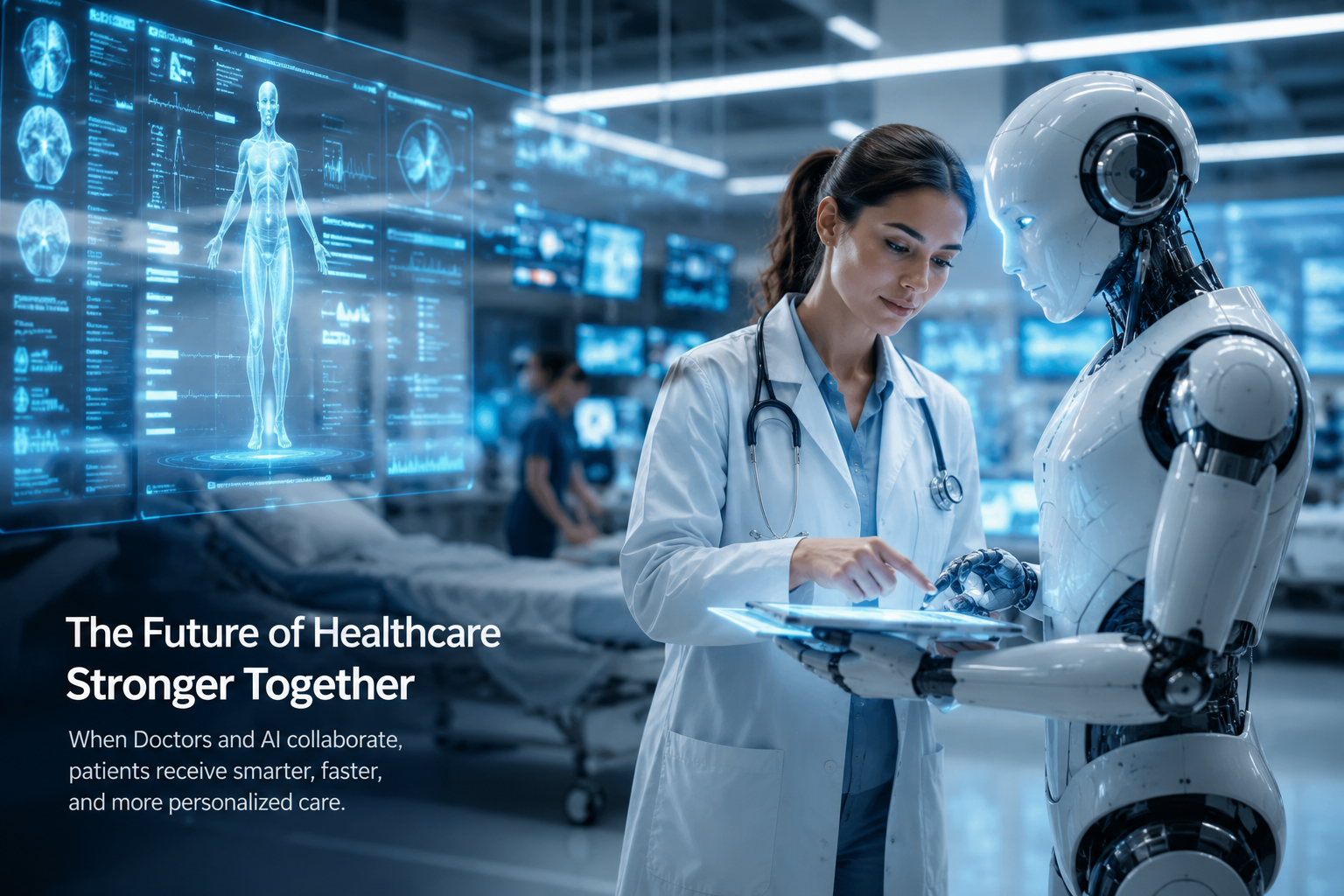
This represents a human-AI collaboration model.
AI can rapidly process data and identify potential abnormalities.
The physician can then interpret those findings using clinical knowledge and patient-specific context.
This approach combines computational power with human judgment.
WHO’s guidance emphasizes that AI should support healthcare rather than be treated as an unquestionable replacement for clinical responsibility.
Why Doctors Still Matter
Medicine isn’t simply a pattern-recognition problem.
Doctors must make decisions when information is incomplete.
A patient may have several symptoms that don’t fit neatly into one disease category.
A test can be misleading.
A patient’s medical history can completely change the meaning of a result.
And sometimes the most important information comes from a conversation with the patient.
Human clinicians also have responsibilities involving communication, informed decision-making, ethics, and accountability.
AI cannot simply be handed complete responsibility for these decisions.
Could AI Replace Doctors in the Future?
It is unlikely that the future of medicine will be as simple as AI versus doctors.
A more realistic future is likely to involve increasingly sophisticated collaboration between clinicians and AI systems.
Doctors may use AI to:
- Screen patients
- Analyze medical images
- Identify potential diagnoses
- Detect high-risk patients
- Summarize medical records
- Support clinical decision-making
- Monitor disease progression
- Assist with personalized treatment
At the same time, clinicians will remain responsible for evaluating whether an AI-generated recommendation actually makes sense for the individual patient.
The Biggest Challenge: Trust
If doctors are going to rely on AI, they need to understand its limitations.
An AI system that simply produces a prediction without explaining its reasoning can be difficult to trust.
This is why researchers are focusing on explainable AI, validation, monitoring, transparency, and clinical evaluation.
WHO has repeatedly emphasized transparency, accountability, safety, equity, and human oversight as important principles for AI in healthcare.
What Does the Future of AI Diagnosis Look Like?
The future could be remarkably powerful.
AI may eventually combine information from medical images, laboratory tests, genetic data, wearable devices, electronic health records, and patient histories.
Instead of analyzing one medical test at a time, future systems could potentially evaluate a patient’s health from multiple sources simultaneously.
Large multimodal AI models are already being investigated for applications across healthcare, scientific research, public health, and drug development. WHO has published specific guidance addressing the opportunities and risks associated with these systems.
But greater capability also means greater responsibility.
The technology must be thoroughly validated before it becomes responsible for high-stakes medical decisions.
The Bottom Line: Can AI Diagnose Better Than Doctors?
Sometimes—but not universally.
AI can be extraordinarily good at specific diagnostic tasks, particularly those involving large datasets and medical images.
But diagnosing a human being is far more complicated than identifying a pattern.
The most promising future may not be a world where AI replaces doctors.
It may be a world where doctors equipped with reliable AI tools can diagnose disease faster, identify subtle abnormalities earlier, and make better-informed decisions.
The real breakthrough may therefore not be AI replacing doctors.
It may be AI and doctors working together.
Frequently Asked Questions
Can AI diagnose diseases accurately?
AI can achieve high accuracy for certain medical diagnostic tasks, but performance varies by disease, dataset, population, and clinical setting. AI results should not automatically be treated as a definitive diagnosis.
Is AI better than doctors at detecting cancer?
In some narrowly defined cancer-detection tasks, AI systems can perform extremely well. However, cancer diagnosis involves much more than detecting an abnormality, and physicians remain essential for clinical interpretation and treatment decisions.
Can AI replace doctors?
AI is unlikely to replace the full role of doctors in the foreseeable future. Instead, AI is increasingly being developed as a clinical decision-support and diagnostic tool.
What are the risks of AI in healthcare?
Major concerns include incorrect predictions, biased training data, privacy issues, lack of transparency, cybersecurity risks, and inappropriate reliance on AI-generated recommendations. WHO recommends strong governance and human oversight for AI in healthcare.
Is AI already used in hospitals?
Yes. AI-enabled medical devices are already authorized for use in the United States across areas including radiology and cardiovascular medicine, among others.
Final Thoughts
Artificial intelligence is no longer just a futuristic idea in medicine.
It is already being developed, evaluated, regulated, and used across multiple areas of healthcare.
The important question is not whether AI is intelligent enough to diagnose diseases.
The bigger question is whether we can develop systems that are accurate, safe, unbiased, transparent, clinically useful, and properly supervised.
If that challenge can be solved, AI could become one of the most important technologies in the history of modern medicine.
And the future doctor may not be replaced by AI.
The future doctor may be the doctor who knows how to use AI.
References
- World Health Organization (WHO). Ethics and Governance of Artificial Intelligence for Health: WHO Guidance.
https://www.who.int/publications/i/item/9789240029200 - U.S. Food and Drug Administration (FDA). Artificial Intelligence-Enabled Medical Devices.
https://www.fda.gov/medical-devices/software-medical-device-samd/artificial-intelligence-enabled-medical-devices - World Health Organization (WHO). WHO Issues First Global Report on Artificial Intelligence in Health and Six Guiding Principles for Its Design and Use.
https://www.who.int/news/item/28-06-2021-who-issues-first-global-report-on-ai-in-health-and-six-guiding-principles-for-its-design-and-use - U.S. Food and Drug Administration (FDA). Artificial Intelligence and Medical Products.
https://www.fda.gov/science-research/science-and-research-special-topics/artificial-intelligence-and-medical-products - U.S. Food and Drug Administration (FDA). Artificial Intelligence in Software as a Medical Device.
https://www.fda.gov/medical-devices/software-medical-device-samd/artificial-intelligence-software-medical-device - World Health Organization (WHO). Health Ethics & Governance: Big Data and Artificial Intelligence.
https://www.who.int/teams/health-ethics-governance/emerging-technologies/big-data-and-artificial-intelligenc