
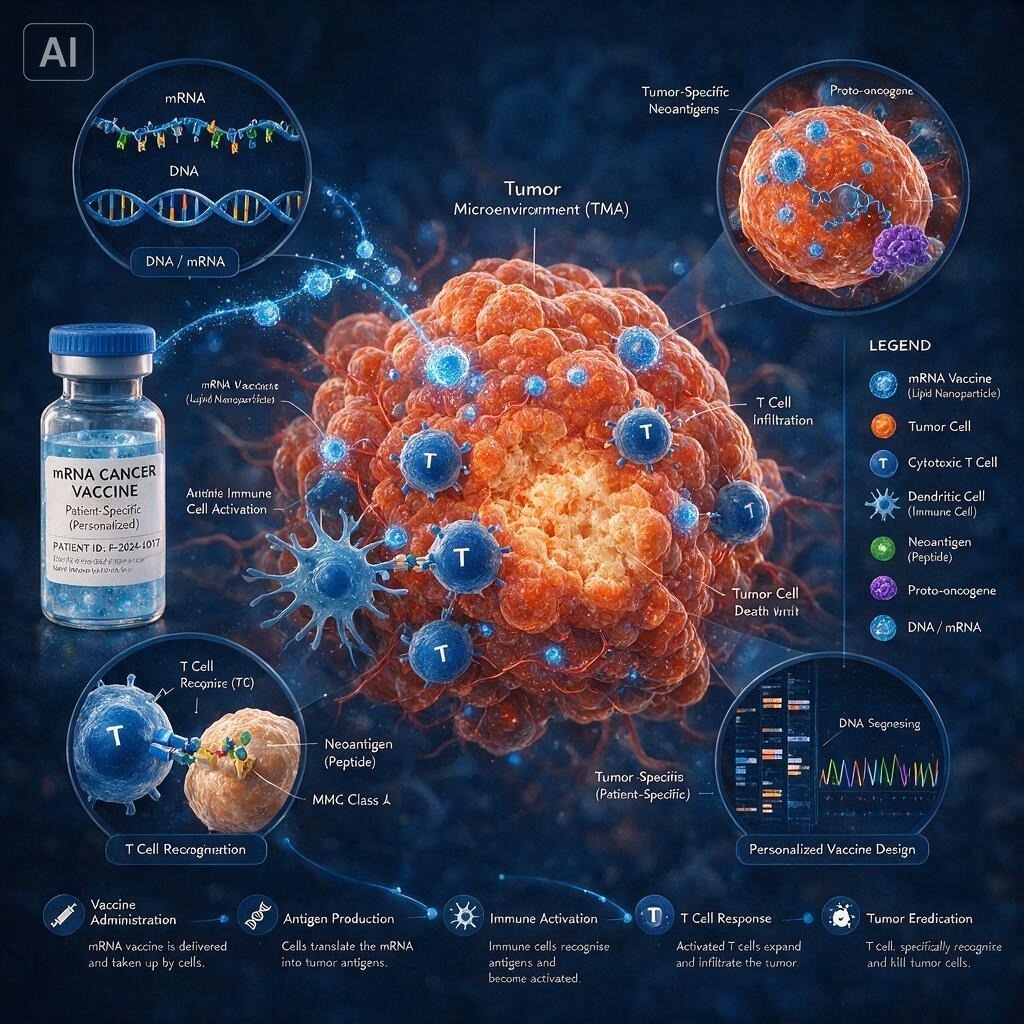
Imagine going to a hospital with cancer and, instead of receiving exactly the same treatment as another patient, scientists take a sample of your tumor, study its genetic mutations, and use that information to design a treatment specifically for you.
It sounds like science fiction.
But this idea is becoming a serious area of modern cancer research.
In August 2026, Moderna and Merck announced promising Phase 3 results for intismeran autogene, a personalized mRNA-based cancer therapy designed around mutations found in an individual patient’s tumor. When combined with the immunotherapy drug pembrolizumab (Keytruda), the treatment reduced the risk of melanoma returning or spreading compared with Keytruda alone in a large late-stage trial.
So, is this actually a vaccine for cancer?
And how can a vaccine be made specifically for one person?
First: What Is a Cancer Vaccine?
Most vaccines are designed to prevent an infection before it happens. They train the immune system to recognize a virus or bacterium.
A therapeutic cancer vaccine is different.
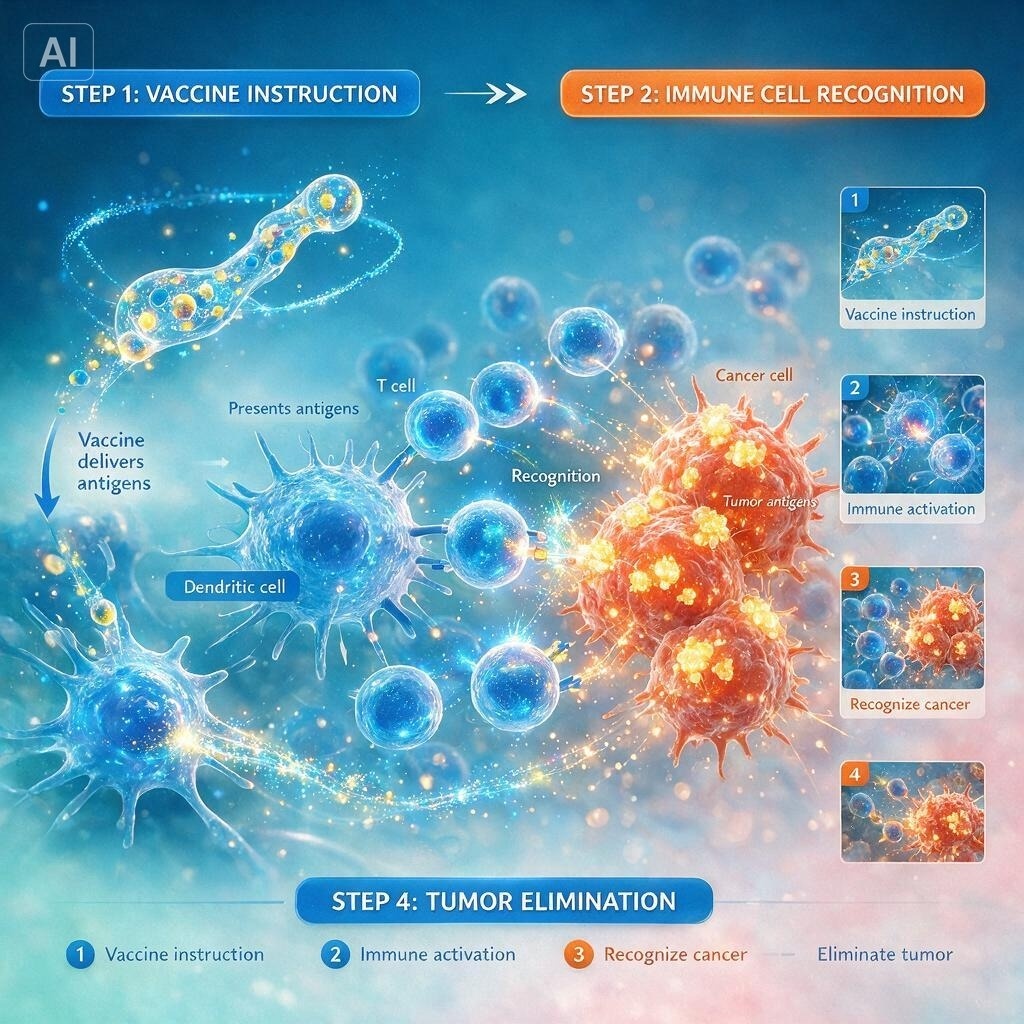
Instead of preparing the immune system for a virus, researchers try to teach it to recognize cancer cells.
Cancer cells can carry unusual proteins or mutations that distinguish them from healthy cells. These abnormal features can produce targets called neoantigens.
A personalized cancer vaccine is designed to help the immune system recognize those tumor-specific targets and mount a stronger response against cells carrying them.
In simple terms:
The tumor provides the clues.
The vaccine teaches the immune system what to look for.
Why Does the Vaccine Need to Be Personalized?
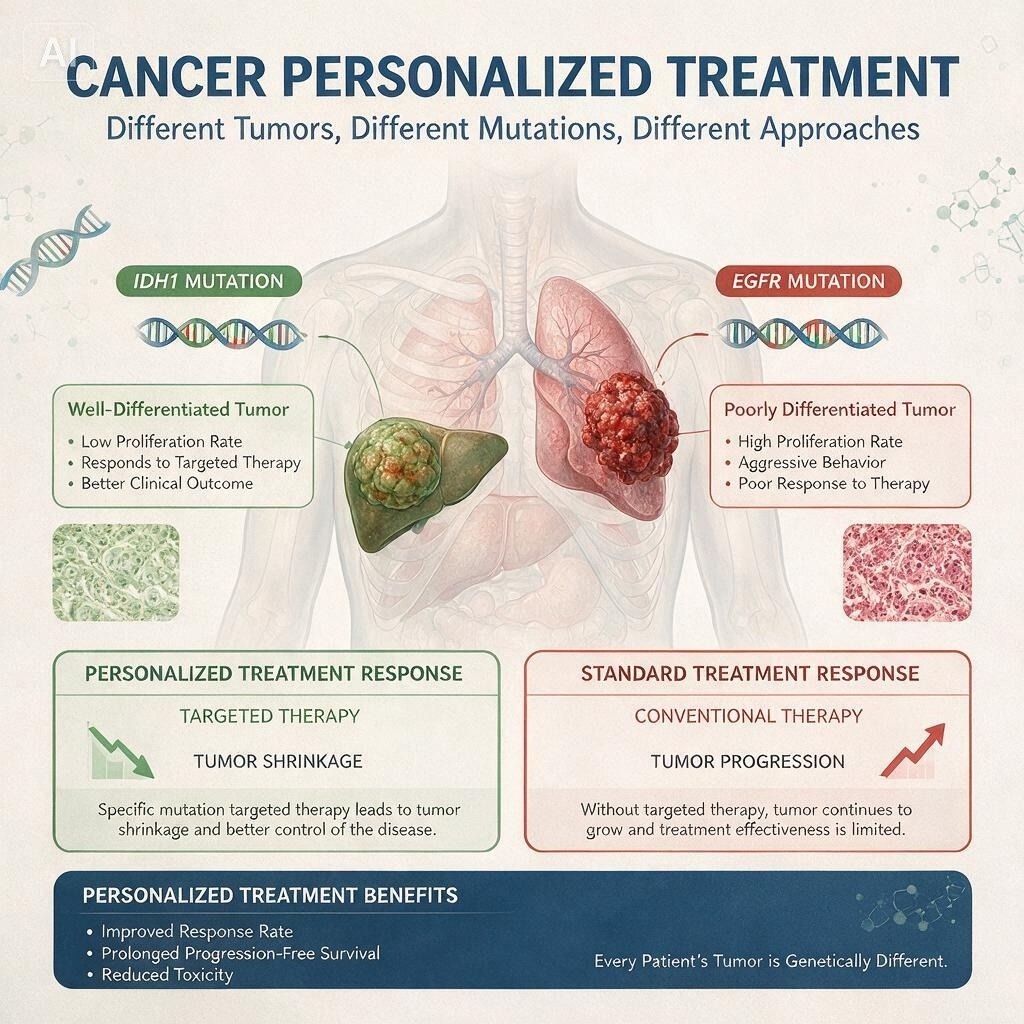
Cancer is not one single disease.
Even two people with the same type of cancer can have tumors with very different genetic mutations.
That creates a problem for conventional treatments: a target that exists in one person’s tumor may not exist in another person’s tumor.
Personalized cancer vaccines attempt to solve this by looking at the individual tumor first.
Scientists can sequence tumor material, compare it with normal tissue, identify mutations that could produce useful immune targets, and select promising neoantigens for the vaccine design.
The result is intended to be much more individualized than a traditional one-size-fits-all treatment.
So Where Does mRNA Come In?
This is where the technology becomes particularly interesting.
mRNA, or messenger RNA, carries temporary biological instructions inside cells.
Instead of putting a complete protein into the body, an mRNA vaccine can provide instructions that allow cells to produce a selected antigen.
For a personalized cancer vaccine, the goal is to use mRNA to present information about tumor-specific targets to the immune system.
The immune system can then learn to recognize those targets and activate cancer-fighting immune cells, particularly T cells.
Think of it like giving the immune system a wanted poster.
The poster does not destroy the criminal.
It tells the security team what the criminal looks like.
The immune system still has to do the attacking.
How Is a Personalized Cancer Vaccine Made?
This process is more complicated than producing an ordinary vaccine.
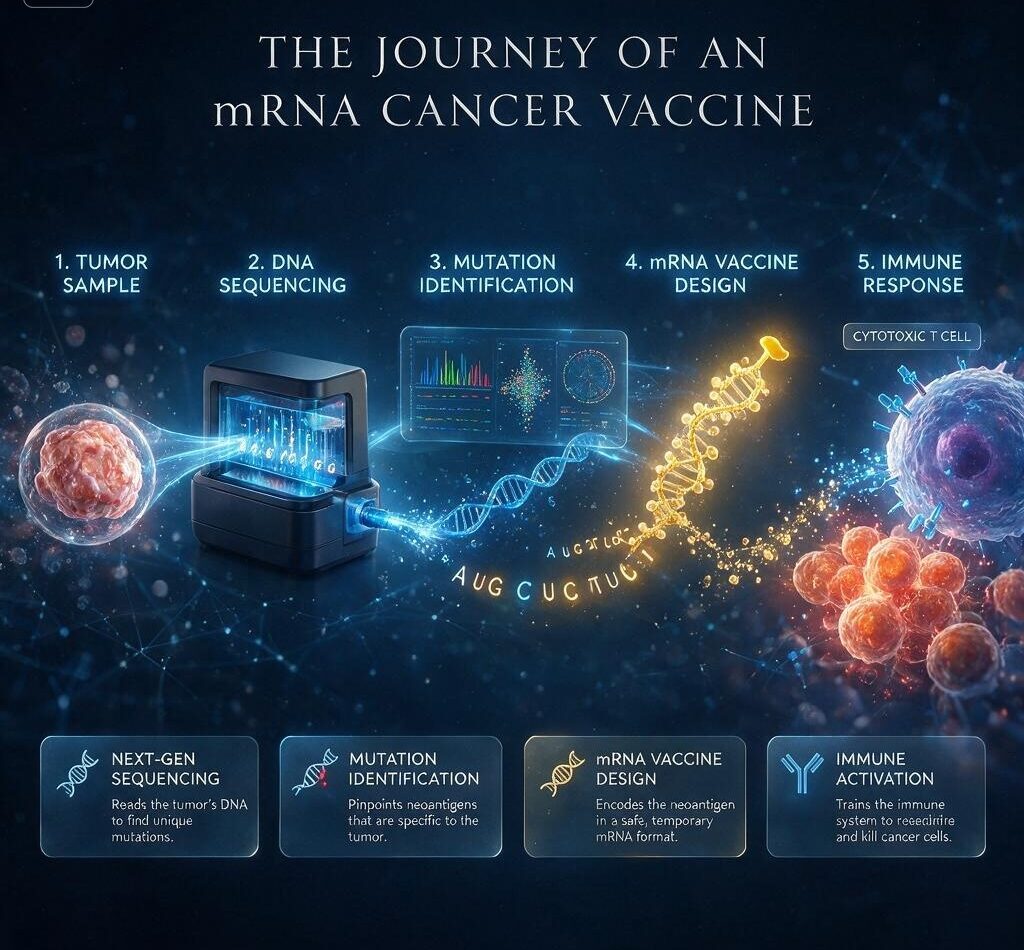
Step 1: The tumor is analyzed
After a tumor is removed or sampled, researchers analyze its genetic information.
They look for mutations that could create recognizable targets on cancer cells.
Step 2: Scientists identify potential neoantigens
Not every mutation is useful.
Researchers use computational methods and biological analysis to predict which tumor-specific changes could potentially be recognized by the patient’s immune system.
Step 3: A personalized vaccine is designed
The selected targets are incorporated into an individualized mRNA vaccine design.
For Moderna’s intismeran approach, the vaccine can target multiple mutations from a patient’s tumor rather than relying on a single target.
Step 4: The vaccine trains the immune system
The vaccine provides instructions intended to help the immune system recognize the selected tumor-associated targets.
This can stimulate a targeted immune response against cells displaying those targets.
Step 5: Immunotherapy can strengthen the response
This is an important part of the Moderna-Merck approach.
The personalized vaccine was studied in combination with Keytruda (pembrolizumab), an immune checkpoint inhibitor.
Checkpoint inhibitors work differently from the vaccine. They can help remove certain brakes that limit T-cell activity.
So the two treatments are designed to work from different directions:
Personalized vaccine → helps the immune system recognize the target.
Checkpoint inhibitor → helps immune cells remain active against cancer.
That combination is one of the reasons this approach has attracted so much attention.
The 2026 Melanoma Breakthrough
The recent development that pushed personalized cancer vaccines back into the spotlight came from a Phase 3 melanoma trial.
On August 19, 2026, Moderna and Merck announced that their personalized mRNA therapy, intismeran autogene, met the trial’s primary and key secondary endpoints when used with Keytruda in patients with completely resected, high-risk melanoma.
The trial included 1,137 patients with surgically removed high-risk melanoma.
The reported results showed that the combination reduced the risk of melanoma recurrence and distant metastasis compared with Keytruda alone. No new safety concerns were reported in the announcement.
This is significant because it represents a major late-stage test of the personalized neoantigen vaccine concept.
However, there is an important distinction:
The treatment is not yet a universally available “cancer vaccine.”
The companies have announced topline Phase 3 results, while more detailed data are expected to provide a fuller picture of efficacy and survival outcomes. Overall-survival data were not yet available in the initial announcement.
This Idea Did Not Start in 2026
The recent Phase 3 result did not appear out of nowhere.
Earlier studies had already suggested that personalized mRNA cancer vaccines could generate meaningful immune responses.
In the Phase 2b KEYNOTE-942 study, patients with high-risk melanoma received either pembrolizumab alone or pembrolizumab combined with the personalized vaccine.
Five-year results reported in 2026 continued to show a substantial reduction in the risk of melanoma recurrence or death with the combination, supporting the idea that the immune response could persist over time.
The new Phase 3 result therefore represents an important next step: moving from promising earlier-stage evidence toward larger late-stage validation.
Could This Work for Other Cancers?
Possibly — but that is still being investigated.
Researchers are studying personalized cancer vaccines across several tumor types, including lung, pancreatic, kidney, bladder and other cancers.
Different cancers present different biological challenges.
Some tumors have more mutations than others. Some create an environment that suppresses immune responses. And some may contain fewer mutations that can be effectively targeted.
So a strategy that works well in melanoma may not automatically work equally well in every cancer.
What Makes Personalized Cancer Vaccines So Exciting?
There are three major reasons.
1. They are individualized
Instead of searching for one universal cancer target, researchers can use the unique genetic characteristics of an individual’s tumor.
2. They use the immune system
Rather than directly attacking cancer cells with a conventional drug alone, the strategy aims to train the patient’s immune system to recognize tumor-specific targets.
3. mRNA is adaptable
The mRNA platform can be redesigned according to the selected targets, making it attractive for individualized therapeutic approaches.
But “promising” does not mean “perfect.”
The Biggest Challenge: Making One Vaccine for One Person
Personalization creates a manufacturing problem.
A conventional vaccine can be produced in large batches.
A personalized cancer vaccine is different.
If every patient’s tumor has a different set of mutations, each patient’s vaccine may require its own design and manufacturing process.
That means researchers need to make the process:
Fast. Accurate. Reliable. Scalable.
The faster scientists can go from tumor sequencing to a finished vaccine, the more practical this approach could become.
Another Big Question: Will It Improve Survival?
Preventing recurrence is important.
But researchers ultimately want to know whether these treatments help people live longer.
The latest Moderna-Merck announcement provided encouraging evidence for recurrence and metastasis outcomes, but overall-survival data were not yet available in the initial report.
That is why the next stage of research matters.
A successful clinical result is not the end of the story.
It is another piece of evidence.
Could Cancer Treatment Become Truly Personalized?
This is perhaps the most fascinating possibility.
Imagine a future in which cancer treatment does not begin with simply asking:
“What type of cancer is this?”
Instead, doctors could increasingly ask:
“What makes this patient’s cancer genetically unique?”
That information could then influence the selection or design of treatments.
Personalized vaccines are one part of a much larger movement toward precision oncology, where treatment decisions are increasingly guided by the molecular characteristics of an individual’s tumor.
The Bigger Picture
The most exciting part of personalized mRNA cancer vaccines may not be that scientists have created a “vaccine against cancer.”
That description is too simple.
The bigger breakthrough is the possibility of combining:
Tumor sequencing + AI/computational prediction + mRNA technology + immunotherapy
into a treatment designed around the biology of one patient’s cancer.
That is a very different philosophy from traditional medicine.
Instead of giving every patient the same solution, medicine could increasingly build the solution around the patient.
So, Can a Vaccine Really Be Made for Your Cancer?
The answer is:
Researchers are getting much closer — but the technology is still developing.
The 2026 melanoma results from Moderna and Merck are an important milestone for personalized mRNA cancer vaccines, but they should not be interpreted as proof that one vaccine can cure every cancer.
For now, the strongest evidence is in specific clinical settings, particularly high-risk melanoma studied alongside immunotherapy. More research is needed to determine how broadly the approach can work and whether it can improve long-term survival.
But the concept itself is remarkable.
Your tumor has its own genetic fingerprint.
Scientists can read that fingerprint.
They can identify potential targets.
And with mRNA technology, they can attempt to turn that information into instructions for your immune system.
The future of cancer treatment may not be one vaccine for everyone.
It may be millions of highly personalized vaccines — potentially one designed around each patient’s cancer.
And that could change the way we think about cancer treatment altogether.
📚 References
- National Cancer Institute (NCI) — Neoantigen Vaccines: A New Approach to Cancer Treatment
NCI Cancer Currents - Merck & Co. / Moderna — Official information on the Phase 3 melanoma study of intismeran autogene (V940).
Merck Newsroom - PubMed — Long-term results from the KEYNOTE-942/mRNA-4157 melanoma study.
PubMed – KEYNOTE-942 study - ClinicalTrials.gov — Clinical trial information for personalized neoantigen therapy in melanoma.
ClinicalTrials.gov - Reuters — August 19, 2026 — Coverage of the Moderna/Merck Phase 3 melanoma vaccine results.
Reuters report - Reuters — August 25, 2026 — Explanation of how the Moderna/Merck personalized cancer-vaccine approach works and potential barriers to wider use.
Reuters analysis